Owning vs Chartering a Yacht: Break-Even Calculation
How many weeks of use make owning a yacht cheaper than chartering? A transparent break-even calculation with charter rates, running costs and depreciation.
Owning a yacht is a fixed annual cost whether you use it for two weeks or twenty. Chartering is a variable cost that scales with every week you use. The break-even point is the number of weeks of personal use where the two cost the same. This guide shows how to calculate it with a transparent example you can adapt to your own numbers.
Quick answer
In our illustrative example, a €6m yacht costs about €900,000 a year to own, and a comparable charter yacht costs about €70,895 a week in base rate. The break-even is roughly 13 weeks of personal use per year. Below that, chartering is cheaper on paper. Above it, owning wins on cost.
The formula
Break-even weeks = annual cost of owning ÷ weekly charter rate
Annual cost of owning includes running costs and depreciation. Add financing interest and opportunity cost if you want a fuller comparison.
Inputs and where they come from
| Input | Value used | Basis |
|---|---|---|
| Yacht value | €6,000,000 | Illustrative |
| Running costs | 10% of value = €600,000 | Industry rule of thumb of roughly 10% to 15% of value per year |
| Depreciation | 5% of value = €300,000 | Assumption. See yacht depreciation |
| Annual cost of owning | €900,000 | Sum of the above |
| Weekly charter rate | €70,895 | Published average for 30 to 40 m yachts (BOAT International via The Luxury Playbook) |
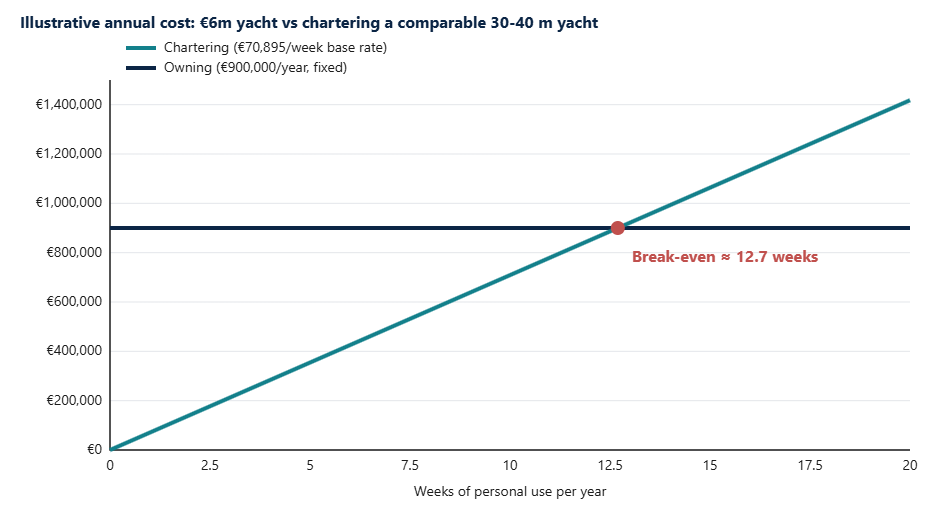
€900,000 ÷ €70,895 = 12.7 weeks.
What the simple model leaves out
- Charter extras: the base rate is not the whole bill. Fuel, food, dockage, taxes and crew gratuity sit on top (how much it costs to charter a yacht), which pushes the real charter cost higher and the break-even lower.
- Acquisition and sale costs: buying and selling add costs of their own. See the guide to broker commission and closing costs.
- Opportunity cost of capital: €6m tied up in a yacht cannot earn a return elsewhere. Including it moves the break-even higher.
- Financing interest: if you borrow, interest adds to the annual cost of owning.
- Crew: included in running costs here, but a large item on bigger yachts (yacht crew cost).
- Convenience and flexibility: charter lets you change boat, size and cruising ground each year. Ownership gives you availability and the freedom to leave the boat set up your way.
Can chartering your own yacht cover the costs?
It can offset a share of the cost, but rarely all of it. One large charter manager estimates that, for a relatively new yacht over 40 metres, the charter rate equals roughly 8% to 10% of annual running costs per week, which puts the owner at break-even on running costs after about 10 to 12 weeks of charter. That is a lot of bookings, and the same source notes that reaching 12 weeks is uncommon. Commercial charter also needs the right registration, compliance and charter insurance, and the VAT and commission treatment affects the net result.
Which is right for you?
- Well below your break-even (about 13 weeks in our example): chartering is usually cheaper, with no depreciation or maintenance exposure.
- Around the break-even: it is a lifestyle decision more than a financial one.
- Well above break-even, or you want the yacht available at short notice: ownership is more efficient per week of use.
Replace our inputs with your own and compare. Start with the annual cost calculator and annual ownership costs.
Frequently asked questions
Is it cheaper to charter than own a yacht?
For limited use, usually yes. Ownership has high fixed costs, so it only becomes cheaper per week once you use the yacht for enough weeks a year.
How many weeks do I need to use a yacht for ownership to make sense?
It depends on yacht size and costs. In our example it is about 13 weeks. Plug in your own running costs, depreciation and charter rate to find yours.
How much do yacht charters cost per week?
Published averages put yachts under 30 m at around €40,000 a week and 30 to 40 m yachts at about €70,895, rising steeply with size. Extras come on top of the base rate.
Will charter income pay for my yacht?
Usually only part of the running costs. Charter income offsets cost rather than eliminating it for most owners.
Sources
- The Luxury Playbook: charter your own yacht for income (charter averages and the 10% to 15% running cost rule)
- SuperyachtNews: are charter rates too expensive?
- Breeze Yachting: can chartering offset ownership costs?
- Charter Compass: ownership vs charter vs fractional ownership