Yacht Broker Commission and Closing Costs: Who Pays What
Yacht broker commission is usually about 10% and paid by the seller. See buyer and seller closing costs, deposits, survey, escrow and a worked example.
The price on a yacht listing is not the full cost of the deal. Broker commission, escrow, documentation, survey and taxes all change what the buyer pays and what the seller actually keeps. This guide explains who pays what, with a worked seller example.
Quick answer
A broker commission of around 10% of the sale price is the long-standing norm, and in most transactions the seller pays it out of the sale proceeds at closing. Seller closing costs overall typically land between 10% and 15% of the final price. Buyers do not normally pay commission directly, but they pay for survey, haul-out, documentation, sales tax where it applies, insurance, and they put down a deposit, commonly 10% of the price, into escrow.
How yacht broker commission works
Commission is a percentage of the final sale price, paid when the sale closes. The money is deducted from the proceeds held in escrow, so the buyer wires the full price and the broker is paid from the seller's side.
- Typical rate: around 10% is the common benchmark. Rates can differ by region, vessel size and the sales method, and commission is negotiable, especially on higher-value yachts.
- Split between brokers: when a buyer's broker is involved, the listing broker usually shares the commission, often roughly half each, so the buyer typically does not pay their own broker separately.
- Tail clauses: many listing agreements keep the broker entitled to commission for a protection period after the contract ends if a buyer they introduced later completes the purchase.
- Regional differences: in some European markets the asking price may exclude the commission, so confirm in writing whether the price you are offered includes it. Buyers also occasionally see a separate buyer's fee, so ask before you sign.
Seller closing costs: what comes out of the sale
Commission is the biggest item, but not the only one. Sellers also face escrow and closing fees, attorney fees, documentation and administrative costs, payoff of any existing loan or lien, prorated registration fees in some jurisdictions, and potentially tax on the gain. Together, seller closing costs commonly run 10% to 15% of the final price.
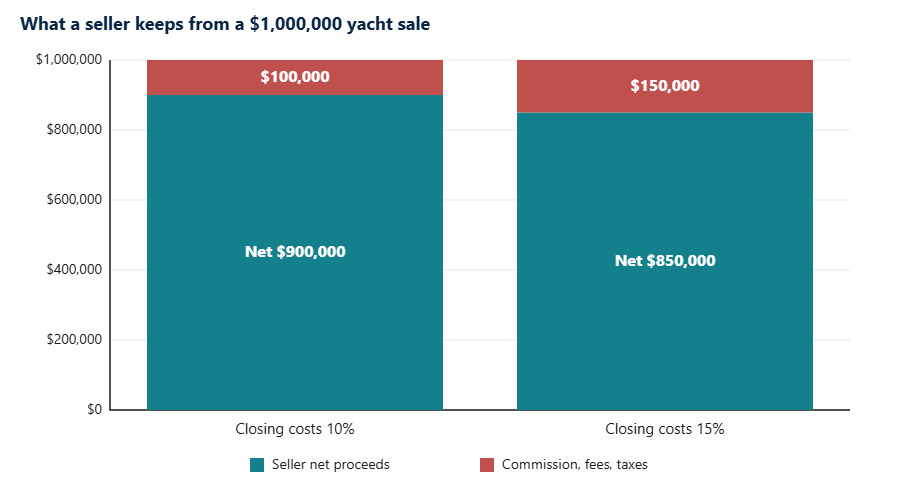
| Sale price | Closing costs | Costs in dollars | Seller net |
|---|---|---|---|
| $1,000,000 | 10% | $100,000 | $900,000 |
| $1,000,000 | 15% | $150,000 | $850,000 |
Illustrative. Before any existing loan payoff or tax on the gain.
Buyer costs beyond the purchase price
- Deposit: commonly 10% of the offer price, held in a third-party escrow or broker trust account once the purchase agreement is signed, and refundable while survey, sea trial and other contingencies are open.
- Survey and haul-out: paid by the buyer. See how much a yacht survey costs and the used yacht survey checklist.
- Sea trial: usually coordinated by the buyer with the seller supplying the captain. Fuel for the trial is generally the seller's cost, since the yacht is still theirs.
- Documentation and registration: paid to the documentation or closing agent. Reported escrow and documentation fees on smaller deals are in the hundreds of dollars per party, and they scale up with vessel size and complexity.
- Sales tax or VAT: the buyer's obligation where it applies, and it varies widely by state and country.
- Insurance and financing: insurance is normally required before closing (yacht insurance cost), and a loan adds its own fees. See our guide to yacht financing.
From offer to closing: the timeline
- Sign a purchase agreement with contingencies for survey, sea trial, financing and insurance.
- Pay the deposit into escrow.
- Complete haul-out, survey and sea trial within the contingency period, typically 7 to 14 days.
- Negotiate repairs or a price adjustment based on the survey, or walk away within your rights.
- Close: funds move through escrow, the title is transferred and the registration or documentation is completed. Signed agreement to closing commonly takes 14 to 30 days depending on survey findings and paperwork.
Never waive the survey contingency. It is the buyer's most important protection.
How to reduce the cost
- As a seller, ask for a lower commission when the yacht is priced right or you have a buyer lined up, and compare brokers on marketing plan and sales history, not only the percentage.
- Prepare service records and documentation before listing, so survey findings give the buyer less to negotiate with.
- As a buyer, confirm in writing who pays which fees and whether the quoted price includes commission.
- Budget the full first-year picture with the annual cost calculator and read how much it costs to own a yacht.
Frequently asked questions
Do buyers pay yacht broker commission?
Usually not directly. The seller pays the commission from the proceeds at closing, although the cost can be reflected in the asking price.
Is yacht broker commission negotiable?
Yes. Rates are commonly around 10%, but structure and percentage can be negotiated, including reduced commission above an agreed price.
How much deposit do I pay when buying a yacht?
Commonly 10% of the offer price, held in escrow while contingencies such as survey and sea trial are completed.
Who pays for the survey?
The buyer normally pays for the survey and the haul-out, though the seller may cover the sea trial fuel.