Electric Yacht Tender Cost: Outboard vs Jet, Range and Charging
Compare electric yacht tender costs, portable outboards and integrated jets, real-world range, charging and battery replacement with dated examples.
Research checked: October 15, 2026
An electric yacht tender can mean two very different purchases: a conventional inflatable dinghy with a removable electric outboard, or a purpose-built boat with an integrated electric jet drive. The first is portable and comparatively simple to price. The second can carry more people at higher speeds, but its carbon hull, battery system and controls place it in a premium category.
This guide compares purchase cost, real-world range, charging and battery replacement. Published prices below are dated examples, not a market average. Your yacht’s davit limits, storage space, typical passenger load and shore-power access matter as much as the motor specification.
Electric Yacht Tender Cost: Quick Answer
A small tender can start with a hull and a separate motor. Zodiac lists its Cadet Alu inflatable range from €841 excluding VAT; that price excludes the motor, assembly and delivery. A 2026 retailer listing in the Netherlands showed a Torqeedo Travel Essential Package S at €2,805 and a separate 1,080 Wh Travel battery at €1,330. These are separate listings and should not be added into a universal installed price: confirm tax treatment, included charger and current compatibility with the seller.
At the other end, integrated electric jet tenders such as the 3.25 m MC-ZERO 325 and 4.5 m MC-ZERO 450 publish 16 kWh and 32 kWh battery capacities respectively, with twin 30 kW drives on the larger model. The manufacturer asks buyers to enquire for a quote rather than publishing a retail price. Budget this as a vessel-specific premium tender purchase, not as a direct comparison with a portable outboard package.
| Option | Published example | What the figure covers |
|---|---|---|
| Inflatable hull | Zodiac Cadet Alu from €841 ex VAT | Hull price; no engine, assembly or delivery |
| Portable electric outboard | Torqeedo Travel Essential Package S €2,805 | Retailer listing; confirm included equipment and tax |
| Replacement Travel battery | 1,080 Wh battery €1,330 | Retailer listing; verify exact motor generation compatibility |
| Integrated electric jet tender | MC-ZERO models; quote required | Complete high-performance craft with integrated propulsion |
Use these examples to frame supplier questions, not to infer a universal all-in price. A hull and motor may be sold by different companies, and a tender package may still need a charger, battery, davit cradle, cover, delivery or commissioning.
Portable Electric Outboard vs Integrated Electric Jet
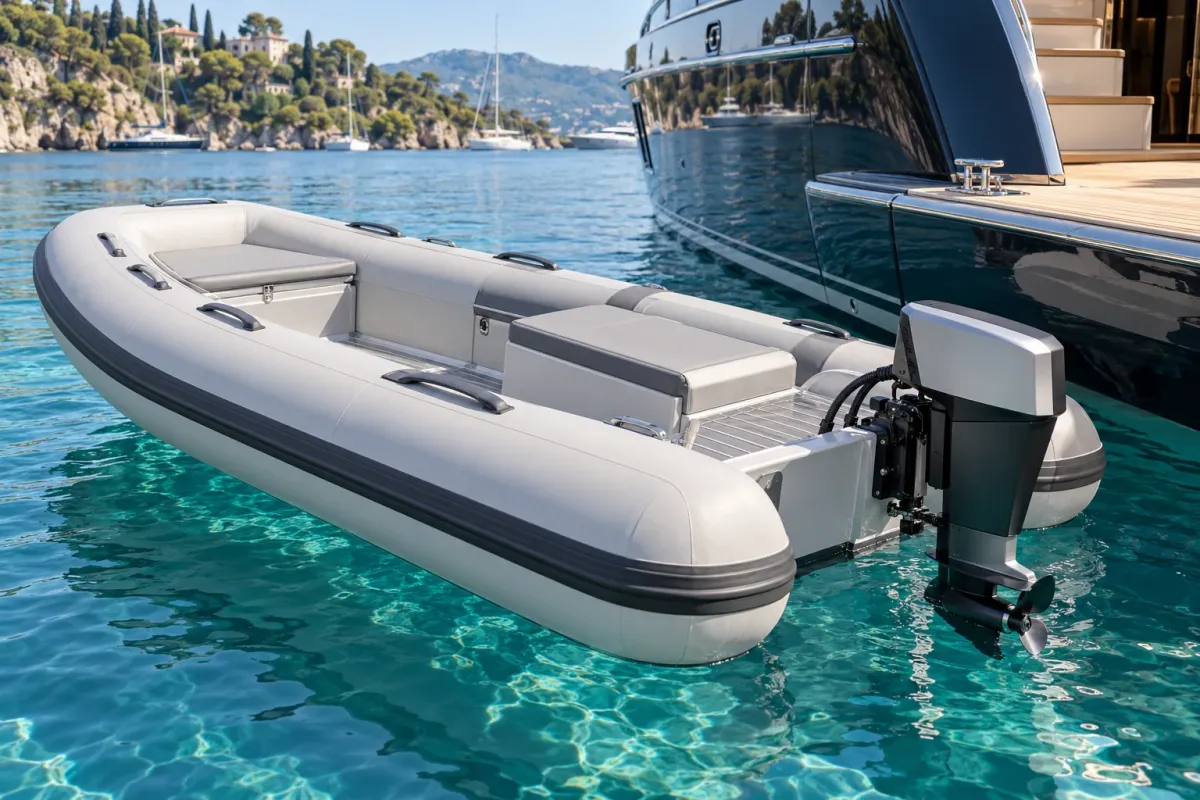
A portable electric outboard fits an existing tender if the transom, shaft length, permitted motor power and total load are suitable. It can be lifted off for charging or stored separately, and the dinghy remains usable with another compatible motor. Zodiac’s Cadet Alu example spans 2.70 to 3.50 m, weighs 46 to 65 kg and is rated for 4 to 6 people; the maker lists 8 to 20 hp maximum power. Check the exact model’s plate and manual before selecting an electric motor.
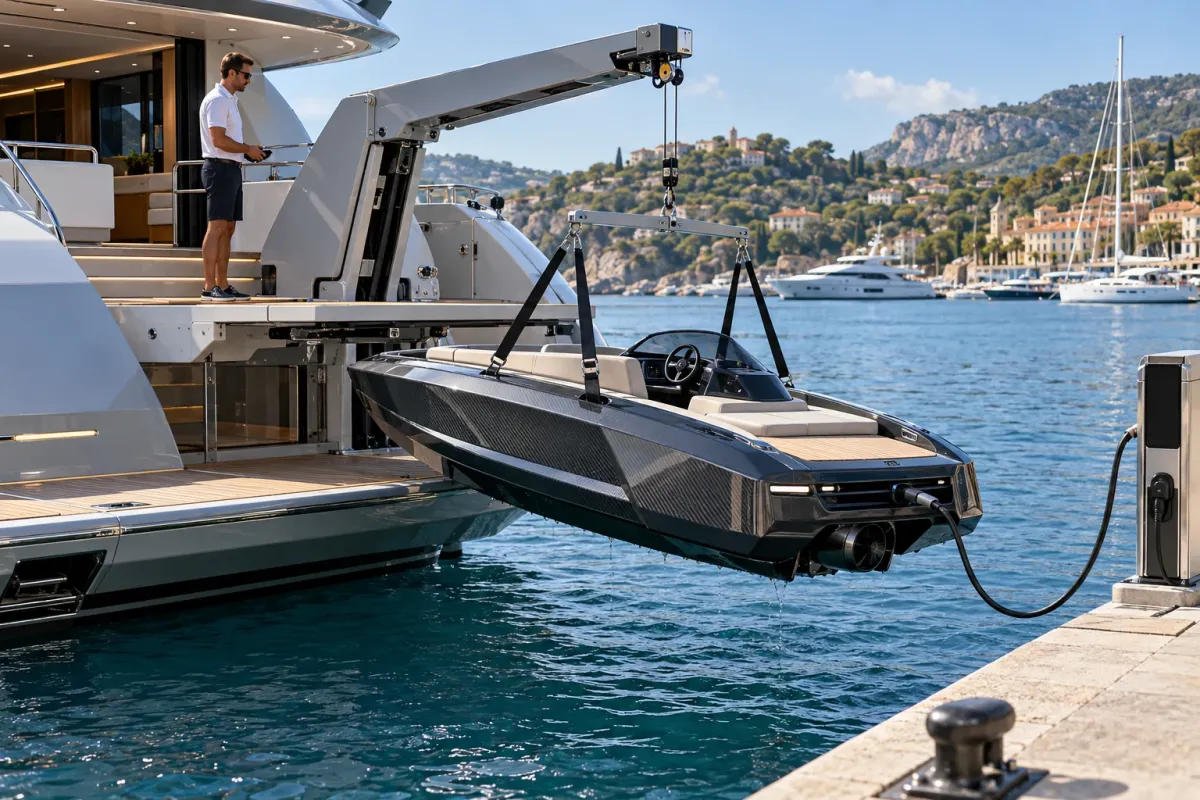
An integrated jet tender is designed around its battery, jet units and controls. It avoids a propeller projecting below the hull and can offer a different passenger layout, but the full boat is heavier and less portable. The MC-ZERO 325 is listed at 446 kg with 5–6 seats. The MC-ZERO 450 is listed at 780 kg with 8–9 seats and twin 30 kW jets. Those weights make davit capacity, crane arrangement and yacht garage dimensions essential parts of the purchase decision.
“Electric jet” describes propulsion, not a promise of long range at top speed. Jet drives and planing hulls can consume substantial power when pushed fast. Ask for a range curve at your intended passenger load and cruise speed, and clarify whether the figure is a maker estimate or a measured sea trial.
Range: Published Numbers Need Context
Torqeedo’s Travel S is an 1,100 W, 3 hp-equivalent outboard with a 1,080 Wh integrated battery. In the manufacturer’s published test for a 3.8 m inflatable dinghy, it reports about 22 km at 5.6 km/h on a slow setting (3 hours 56 minutes), 14.9 km at 7.6 km/h at half power (1 hour 58 minutes), and 8.5 km at 8.6 km/h at full power (47 minutes). The same maker says its larger Range Package can extend range by up to 32%.
These are test results, not a guarantee for your tender. Boat shape, propeller, current, wind, temperature, battery age and total passenger or gear weight all change the outcome. A short harbor transfer at low speed is a different duty from repeatedly carrying a full load against a chop.
For an integrated high-speed comparison, ZeroJet lists the MC-ZERO 450 at up to 24 knots and gives a range example of 18 nautical miles with one driver at 18 knots. It also describes optional range-extending batteries and more than 20 nautical miles at 12 knots with those options. Treat the speed and range statements as manufacturer figures for the specified setup; request the exact configuration and load assumptions in writing.
Charging and Day-to-Day Running Cost
A portable battery is convenient only if you can remove it safely and charge it where the manufacturer permits. Confirm the supplied charger’s input, charge time, connector and environmental limits. A 1.08 kWh battery requires at least 1.08 kWh of energy at the battery to refill from empty; wall consumption is higher because charging is not perfectly efficient. As an illustration, at €0.30 per kWh and an assumed 15% charging loss, a full refill would use about 1.24 kWh from the socket and cost roughly €0.37. This is a calculation example, not a quoted marina tariff or exact charger result.
Small charging cost does not mean zero ownership cost. Count battery purchase or eventual replacement, charger storage, corrosion checks, propeller inspection, seals and any service required by the maker. A removable battery also needs a dry, secure place to charge and store. Follow the supplied manual for temperature, charging and long-term storage.
A larger integrated system needs an onboard charging plan. Ask whether the boat uses shore AC, a fast charger, a yacht DC-to-DC connection or another option, and what each option draws from the yacht. If the tender is recharged from the mothership’s house bank, that energy must ultimately come from shore power, a generator, the main engines or solar. Our yacht lithium battery guide and generator cost guide explain those broader energy-system costs.
Battery Replacement: Plan for the Whole Pack
The 2026 retailer example lists a 1,080 Wh Torqeedo Travel battery for €1,330. That gives a concrete replacement reference for this specific portable motor family, but not a general battery price for electric tenders. Verify model compatibility, warranty status, availability and whether the quoted battery includes any required electronics or charger.
MC-ZERO lists 16 kWh for the 325 and 32 kWh for the 450, while its battery system is described as 2.7 kWh modules. The maker lists a five-year battery warranty. It does not publish a module replacement price on the product page, so ask the dealer for battery-pack pricing, labor, diagnostic requirements, expected lead time and whether failed modules can be replaced individually. Do not estimate replacement cost by multiplying a module count by a consumer battery price.
When comparing warranties, ask what capacity or performance threshold applies, how cycle count is measured, whether commercial or frequent charter use changes coverage, and who pays shipping and labor. A warranty term alone does not establish expected service life or replacement cost.
Which Setup Fits Your Yacht?
- Choose a portable outboard setup when the tender is light enough to handle, transfers are relatively short, and you value a removable motor and replaceable dinghy. Match motor thrust and battery capacity to the real load, not just the passenger rating.
- Consider an integrated jet tender when you need more speed, passenger space or a built-in premium platform and your yacht can lift, store and charge the complete craft. Obtain a vessel-specific quote and load-tested range data.
- Keep a combustion option in the comparison for long days, remote cruising or places without dependable charging. Compare the full motor and fuel system, service, noise, storage and refuelling convenience against the electric system rather than comparing energy price alone.
Before ordering, measure the garage and launch path, confirm tender and davit weights with the yacht builder, set a maximum passenger-and-luggage load, and plot a typical day’s distance with a reserve. Then request matching quotes with the charger, battery, cradle, cover, delivery and commissioning listed separately.
Frequently Asked Questions
How much does an electric yacht tender cost?
There is no single comparable price. Dated examples include a Zodiac inflatable hull from €841 excluding VAT and a Torqeedo Travel Essential Package S listed at €2,805 by a European retailer. An integrated jet tender requires a dealer quote. Confirm the exact contents and tax basis of each offer.
How far can an electric tender travel?
Range varies sharply with speed and load. Torqeedo’s test on a 3.8 m inflatable reports 22 km at a slow 5.6 km/h setting and 8.5 km at full power. Use the exact maker test conditions as context and ask for a safe reserve for your own trip.
How much does an electric tender battery cost to replace?
The retailer example for a 1,080 Wh Travel battery is €1,330. Large integrated systems do not necessarily have public pack prices; ask their dealer for a written replacement estimate and warranty terms.
Can I charge an electric tender from yacht solar panels?
Possibly, but solar output, battery chemistry, charge controller and the motor maker’s approved charging method must be compatible. Estimate the energy available on a typical day and retain enough reserve for other onboard loads.
Sources and Method
Research checked October 15, 2026. Prices are individual advertised listings and can change; they are not a survey or installed-cost average. Range, speed, battery capacity, weight and warranty figures are manufacturer statements for named models. The charging-cost example is an explicitly hypothetical calculation. YachtMetric has not conducted an independent sea trial, battery-life study or tender installation survey.
- Zodiac Nautic: Cadet Alu dimensions, weight, passenger capacity and starting price.
- De Stille Boot: retailer listings for Torqeedo Travel package and 1,080 Wh battery.
- Torqeedo: Travel S specifications, test range and Range Package claim.
- ZeroJet: MC-ZERO specifications, range examples and warranty statements.
- Yachting Pages: 2026 MC-ZERO launch background.