Hybrid vs Diesel Yachts: Running Costs, Range and Battery Replacement
Compare hybrid and diesel yacht running costs, electric range, charging and battery replacement, with transparent budget examples and manufacturer sources.
Research checked: October 15, 2026
A hybrid yacht can replace some diesel-engine and generator hours with battery power, but that does not automatically make it cheaper to own. The result depends on the purchase premium, your cruising speed, access to charging, maintenance requirements and the eventual cost of battery work.
For buyers comparing hybrid vs diesel yachts, the useful question is: what does each system cost over the same itinerary, at the same speed, with the same onboard comforts? This guide explains the comparison, separates electric range from total range and provides worked examples you can replace with real quotes.
Hybrid vs Diesel Yachts: Quick Comparison
| Question | Conventional diesel yacht | Battery-hybrid yacht |
|---|---|---|
| What powers propulsion? | Diesel engines mechanically drive shafts, pods or other drives. | Diesel and electric propulsion, arranged differently by system. |
| When can the engines be off? | At anchor if separate batteries or shore power support onboard loads. | During battery-powered operation, within power and energy limits. |
| What determines range? | Usable fuel, consumption, speed, conditions and reserve. | Those same factors plus usable battery energy and charging strategy. |
| What belongs in the budget? | Fuel, engine and drivetrain service, generator costs and repairs. | Diesel costs plus electricity, battery condition, electrical-system service and replacement exposure. |
| What must be checked before purchase? | Condition survey, service history and performance data. | The same checks, plus battery diagnostics, warranty terms and specialist support. |
A diesel yacht can also have a large house battery and solar panels. Compare equivalent equipment: quieter nights at anchor are not exclusive to hybrid propulsion.
Understand Which Hybrid System You Are Comparing
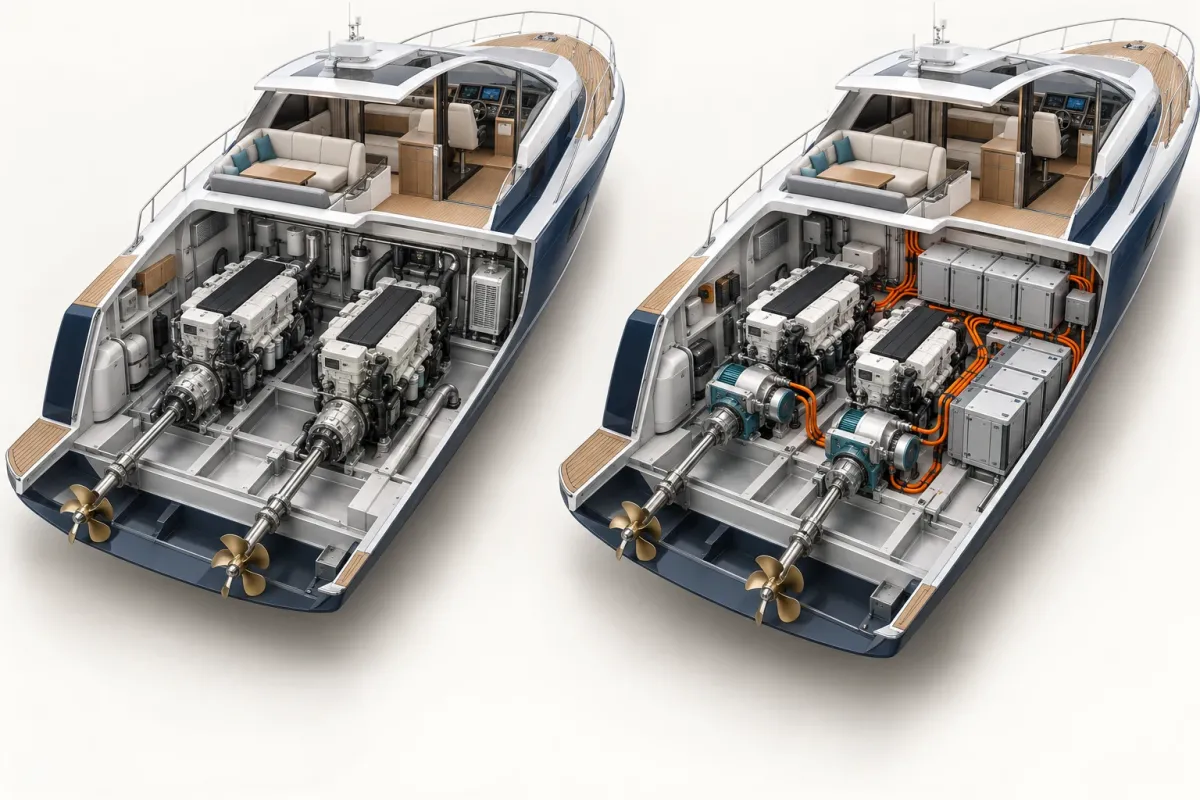
In a parallel hybrid, the engine and electric motor can provide mechanical drive to the propulsion system. In a series hybrid, engines generate electricity and electric motors provide propulsion. A diesel-electric vessel does not necessarily have a large battery or meaningful engine-off range. Ask for the actual system architecture rather than relying on the sales description.
Volvo Penta's hybrid propulsion overview explains these arrangements and describes using electric mode for low-speed operation and combustion power for longer distances. Availability and operating capabilities depend on the installed package.
Running Costs: Compare the Same Trip
Comparing a diesel yacht at 20 knots with a hybrid at 5 knots mixes propulsion choice with a major change in speed. Start with similar hulls, loading and equipment, then compare fuel and electricity over the same distance and speed profile. Our yacht fuel cost guide explains how speed changes the calculation.
Count where electricity comes from. Shore power has a tariff; solar output varies; electricity made by an onboard diesel engine has fuel and servicing costs. Recharging underway is not free energy.
The example below isolates one low-speed part of a season. Every input is an invented budgeting assumption, not a test result, current energy price or claimed saving for a production yacht. It assumes two otherwise comparable installations complete the same 5-knot operation.
| Input or result | Diesel example | Battery-electric segment of hybrid example |
|---|---|---|
| Annual low-speed operation | 50 hours at 5 knots | 50 hours at 5 knots |
| Assumed consumption | 8 litres/hour, both engines combined | 12 kW average battery draw, including onboard loads |
| Season energy use | 400 litres | 600 kWh drawn from battery |
| Assumed energy price | $1.50/litre | $0.30/kWh metered shore electricity |
| Assumed charging efficiency | Not applicable | 90% from shore meter to stored energy |
| Metered electricity required | Not applicable | 600 / 0.90 = 666.7 kWh |
| Segment energy cost | $600 | $200 |
The calculated difference is $400 per year for this segment. The battery is recharged across multiple outings; this example does not assume 50 hours on one charge. It excludes faster cruising, purchase cost, battery aging, maintenance, marina connection fees and generator use. A real comparison needs measured consumption for both boats.
At an assumed $0.60/kWh shore tariff, the electric segment would cost $400 and the difference would fall to $200. If an engine supplies the charging energy instead, replace the shore-power calculation with the actual additional fuel and service costs.
Does the Hybrid Purchase Premium Pay Back?
Obtain comparable written quotations for the diesel and hybrid boats. Match engines, batteries, generator, air conditioning, solar equipment, taxes and commissioning so an equipment difference does not masquerade as a propulsion premium.
Simple payback = additional purchase cost / annual net operating savings.
If the additional cost were an illustrative $40,000 and net annual savings were $2,000 after electricity and maintenance differences, simple payback would be 20 years. These are hypothetical inputs. They exclude financing, resale changes, discounting and future battery replacement. If net savings are zero or negative, there is no operating-cost payback under those assumptions.
Keep comfort benefits separate from financial savings. A buyer may value engine-off maneuvering and quieter evenings even when the purchase premium does not pay back. For the wider budget, see annual yacht ownership costs.
Electric Range Is Different from Total Cruising Range
Ask for electric-only range at a stated speed, battery configuration and hotel load. Hotel loads are the electricity used by air conditioning, refrigeration and other onboard equipment. Also ask for diesel-mode and combined range, with the reserve and test conditions identified. Do not add unrelated brochure figures together.
As a dated manufacturer example, Greenline's 2024 brochure lists a Greenline 48 Fly configuration with an electric range of 25 nautical miles at 5 knots and an electric top speed of 7.5 knots. The 25-mile figure is not a range claim at maximum speed, and the brochure warns that conditions and loading affect performance. It is not a specification for every model year or battery package.
For a separate arithmetic example, assume an 80 kWh nominal battery, a selected 80% usable operating window and a further 20% of that usable energy held back as planning reserve:
- Usable window: 80 × 0.80 = 64 kWh.
- Energy allocated to the trip after reserve: 64 × 0.80 = 51.2 kWh.
- At 12 kW total battery draw: 51.2 / 12 = 4.27 hours.
- At 5 knots: 4.27 × 5 = approximately 21.3 nautical miles.
These are illustrative assumptions, independent of the Greenline example. If total draw rises to 20 kW at the same speed, calculated range falls to 12.8 nautical miles. Use manufacturer-defined usable capacity without subtracting an operating window twice. Weather, battery health, currents and reserve requirements must be assessed for the actual passage; this worksheet is not a safe-range guarantee.
Charging Time and Nights at Anchor
Charging time starts with energy to replace divided by the effective charging power. Replacing 40 kWh with an assumed 7 kW net charging rate takes about 5.7 hours before any tapering or other limitations. The effective rate is constrained by the shore supply, onboard charger, battery limits and simultaneous onboard demand.
At anchor, divide energy allocated to onboard use by average hotel load. An illustrative 30 kWh allocation supports a 3 kW load for 10 hours, or a 6 kW load for 5 hours. Do not allocate the same battery energy to both hotel loads and propulsion.
Solar can contribute, but array rating is power, not daily energy. In its published operating scenario, Greenline assumes 12 kWh per day from a 2.5 kW array. The builder explicitly ties its comparison to its operating assumptions. Use seasonal local output and your own loads rather than treating that figure as a daily guarantee.
Battery Replacement Cost: Request an Installed Quote
A reliable propulsion-battery replacement budget needs the exact pack and a written installed quotation. Automotive battery prices and loose-cell prices do not establish the cost of a compatible marine propulsion system.
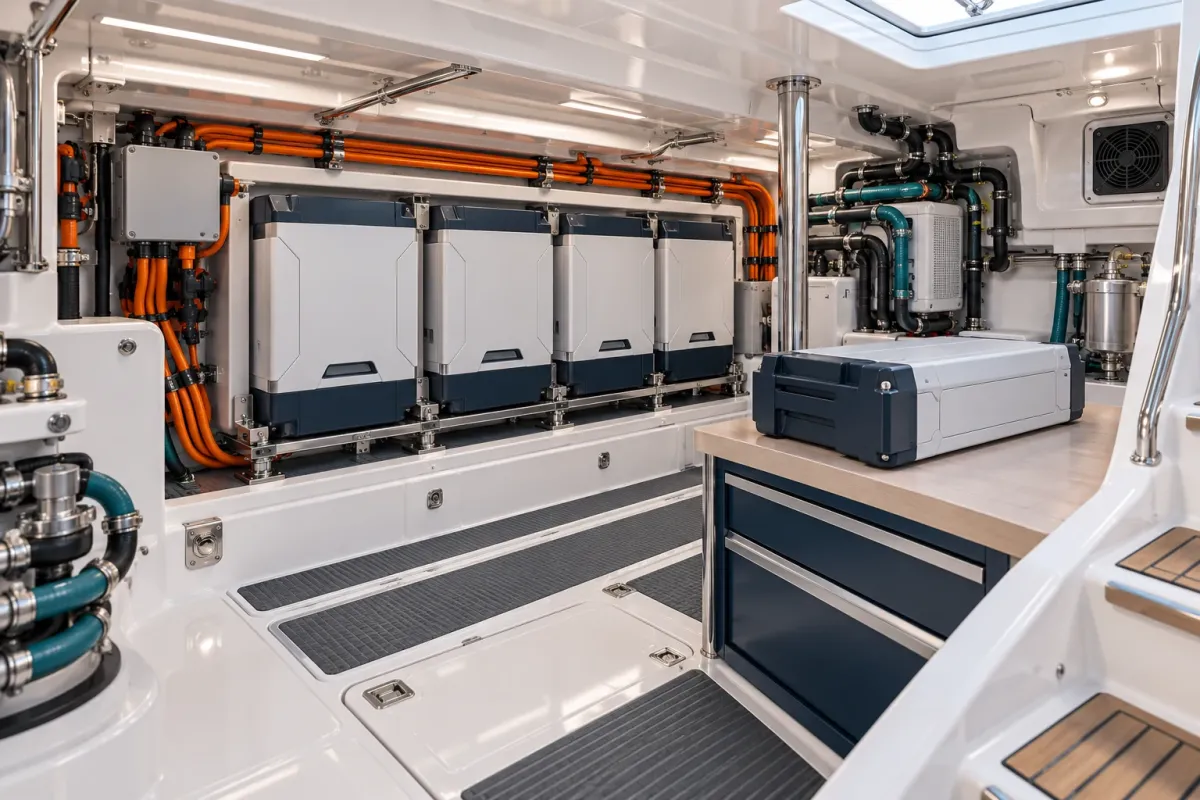
Ask the supplier to itemize:
- Approved battery modules, capacity and compatibility with the existing drive.
- Battery management, cooling, cables, contactors and control-system changes.
- Removal access, lifting, installation labor and commissioning.
- Freight, taxes, old-battery handling and disposal or recycling.
- Warranty, available service locations and expected downtime.
For planning only, if an owner received a hypothetical all-in replacement quote of $48,000 and chose to build a reserve over 12 years, the allocation would be $4,000 per year. This is not a market-price estimate or a prediction of battery life. Replace both inputs with a supplier quote and an ownership scenario. A reserve is money set aside, not an invoice paid every year.
Battery Warranty Is Not a Replacement Schedule
Torqeedo's battery technology page distinguishes a ten-year capacity warranty for its Deep Blue Battery 80 for recreational and commercial use from a nine-year recreational capacity warranty for its Deep Blue Battery 40. These are product-specific terms, not a general warranty for hybrid yachts.
Check the applicable contract for retained-capacity thresholds, usage and temperature conditions, transferability, exclusions and remedy. A capacity warranty does not mean a battery must be replaced when coverage ends, or that every related labor and transport charge is covered.
For a used hybrid, request a specialist battery-health report, commissioning date, diagnostic history and confirmation that replacement modules remain supported. Add these checks to your pre-purchase yacht survey checklist.
Maintenance: Price Both Systems
A hybrid still carries combustion machinery. Obtain the engine, gearbox or pod, and generator service schedules along with requirements for battery cooling, electrical diagnostics, chargers and software. Fewer engine hours do not necessarily remove calendar-based service requirements.
Compare written service proposals for the actual installation. Include specialist travel, access to authorized technicians and parts availability in your cruising region. Use our maintenance budget guide for the other annual expenses.
Which Yacht Fits Your Use?
| Your use | What to investigate first |
|---|---|
| Short, slow trips with dependable charging | Measured electric range, shore tariff and realistic annual electric hours. |
| Long, faster passages | Diesel-mode consumption and range at your normal speed, including hybrid weight and equipment. |
| Frequent nights at anchor | Battery energy available for hotel loads, overnight cooling demand and generator restarts. |
| Low annual usage | Purchase premium, calendar servicing and battery condition relative to modest energy savings. |
| Buying used | Independent survey, battery diagnostics, warranty transfer and installed replacement quote. |
Build two budgets for the same itinerary. Record fuel, electricity and servicing as cash operating expenses; show financing, depreciation and future battery reserves separately. The Yacht Annual Cost Calculator can help assemble the wider ownership budget; record hybrid electricity and battery scenarios separately rather than treating battery power as zero-cost fuel.
Frequently Asked Questions
Are hybrid yachts cheaper to run than diesel yachts?
They can use less diesel when battery operation replaces engine or generator hours. Whether the total ownership cost is lower depends on charging cost, purchase premium, maintenance, battery work and resale value. Compare the same operating profile.
How far can a hybrid yacht travel on battery power?
There is no universal range. Ask for the exact model's tested speed, usable battery capacity, onboard loads and reserve assumptions. Electric-only range and total range with diesel available are different figures.
How much does a hybrid yacht battery cost to replace?
Use an installed quotation for the approved pack. Include integration, access, commissioning, freight and disposal. This article's reserve example is hypothetical and is not a typical replacement price.
Can solar panels run a hybrid yacht indefinitely?
Only if energy generation consistently meets all propulsion and onboard demand over the intended operation. Compare daily energy in kWh with daily consumption; the presence of solar panels alone does not establish energy independence.
Sources and Method
Manufacturer material was checked on October 15, 2026. Specifications and warranties apply to the products and configurations described by each source. Manufacturer range claims are identified as such; all dollar calculations and unsourced operating inputs above are explicit illustrative scenarios, not market averages or independent sea trials.