Yacht Air Conditioning Cost: Installation, Power Use and Battery Runtime
Compare yacht air-conditioning equipment and installation costs, estimate power use and battery runtime, and plan a system around your boat.
Research checked: October 15, 2026
Marine air conditioning can be a single self-contained cabin unit or a central chiller serving several zones. The purchase price is only one part of the budget: installation may involve seawater plumbing, electrical protection, ducting, condensate drainage and access work. Running cost depends on the unit's actual electrical input, how often its compressor operates and how that power is supplied.
This guide compares equipment and installation costs, explains how to size a yacht air-conditioning system, and works through shore-power, generator and battery examples. Prices and calculations are identified as such so you can replace them with a quote for your own vessel.
Yacht Air Conditioning Cost: Quick Answer
A live European retailer listing checked on October 15, 2026 advertised a complete Dometic MCS T12 230 V marine air-conditioning kit for €5,120.50, reduced from €5,390. The listing describes a 12,000 BTU/h heating and cooling unit and includes a seawater pump, air grilles, hose and controller. It is one retailer's equipment package, not an installed-cost average; confirm stock, tax, freight and included parts directly before buying.
That unit is listed at 1,030 W electrical input while cooling. Installation, haul-out, new through-hull fittings, electrical upgrades or longer duct runs may add substantial cost. Ask for an itemized, vessel-specific quote that separates the unit from all labor and supporting equipment.
| Budget item | What to confirm |
|---|---|
| Air-conditioning equipment | Exact model, cooling output, voltage, frequency, included controls and pump. |
| Seawater system | Intake, seacock, strainer, pump, hose, discharge and required flow. |
| Air distribution | Ducts, grilles, return-air path, insulation and cabin zoning. |
| Electrical work | Starting current, breaker, cable, shore-power capacity, generator or inverter changes. |
| Installation and commissioning | Access, removal, carpentry, leak and flow checks, controls and sea trial. |
Self-Contained Units vs Chillers
A self-contained unit combines the compressor and cabin air handler in one package. It commonly suits one cabin or a small boat, with short air ducts and a seawater loop for heat rejection. Several cabins may use separate units, each with its own controls and service points.
A chiller uses a central refrigeration plant to cool circulating water. Air handlers in cabins then transfer heat to that chilled-water circuit. This can make sense for multiple zones or larger yachts, but adds pumps, piping, controls and commissioning. The equipment price alone cannot show which approach will be cheaper after installation.
Webasto's published BlueCool S-Series specifications cover self-contained models from 6,000 to 27,000 BTU/h depending on voltage. Its C-Series chiller range lists models from 16,000 BTU/h upward. These are distinct product families; compare complete designs, not just cooling-capacity labels.
How Much Cooling Capacity Does a Yacht Need?
Capacity is often stated in BTU per hour. One refrigeration ton equals 12,000 BTU/h. Do not select a unit only from yacht length: cabin area, window exposure, insulation, climate, ceiling height, occupancy and the seawater temperature all affect the heat load.
Dometic's marine AC guide divides a yacht into below-deck, mid-deck and above-deck areas, then applies different climate load factors. Its example factors rise from 60 to 120 BTU/h per square foot in temperate conditions and from 90 to 150 in tropical conditions, depending on deck location. These are planning factors in the manufacturer's guide, not a substitute for a heat-load assessment on a specific boat.
The same guide asks owners to plan the return-air opening, duct path, service clearance and seawater components. It gives 3 gallons per minute of seawater flow for a 12,000 BTU/h system as a selection reference. Actual requirements must follow the chosen unit's current manual and installation design.
An undersized system may struggle during hot weather; an oversized system can cost more and may cycle in a way that fails to control humidity well. Ask the installer to show the cabin-by-cabin load estimate, selected capacity and assumed air and water temperatures.
What Does Installation Add?
Before accepting a quote, check whether the unit can be moved through the boat and serviced after installation. A technically suitable model can become an expensive project if cabinetry must be removed or rebuilt to reach it.
- Removal and disposal of the old unit, if this is a replacement.
- New seacock or through-hull, seawater strainer, pump, hoses and discharge routing.
- Electrical cable, breaker, isolation, control wiring and any shore-power or generator changes.
- Insulated ducting, cabin grilles, return-air opening, condensate drain and sound isolation.
- Mounting, carpentry, sealing, commissioning, flow checks and operator handover.
For a replacement, do not assume the old hoses, wiring or fittings are suitable for a new model. Ask the installer to record what will be reused and why. For a multi-zone chiller, request separate line items for the plant, pumps, piping, air handlers, controls and commissioning so bids can be compared on the same scope.
Power Use and Annual Running Cost
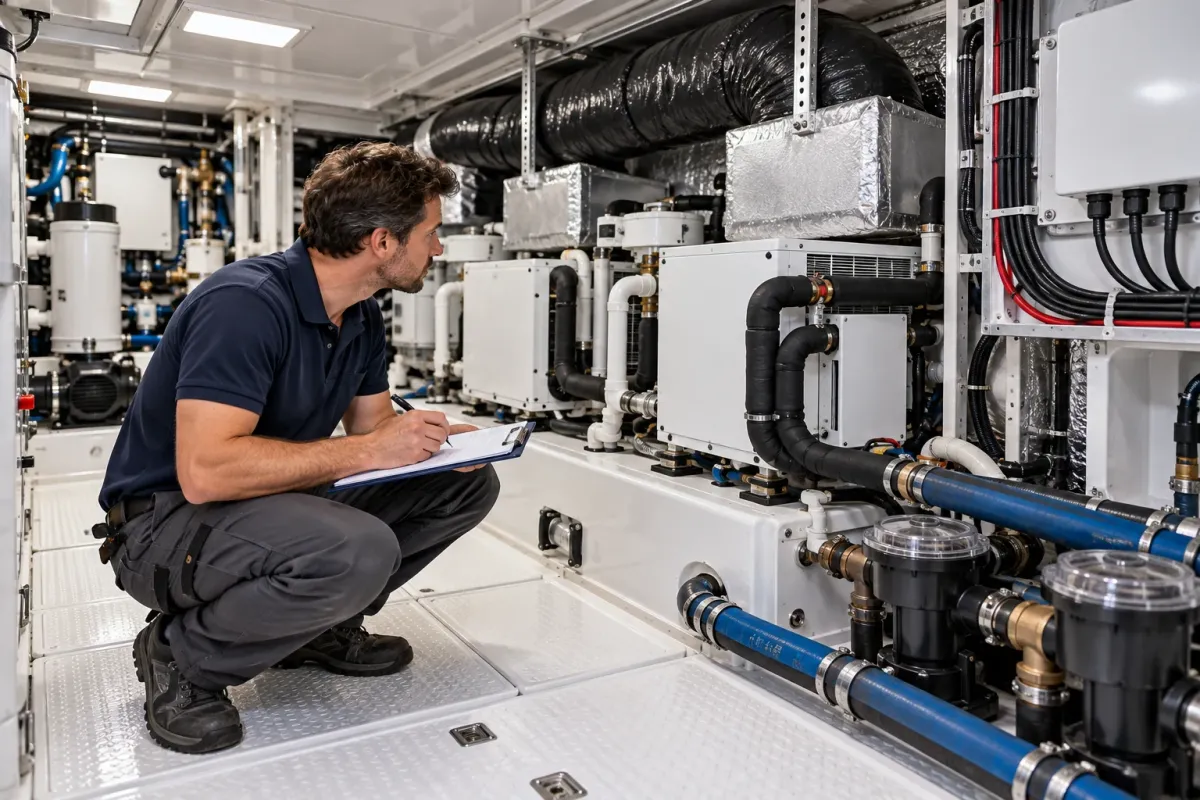
Use the model's electrical input, not cooling output, when estimating electricity. The Dometic T12 retailer listing gives 1,030 W input while cooling and 230 V supply. At continuous rated input, one hour uses about 1.03 kWh. The compressor may cycle or vary in real conditions, so a full-season estimate needs measured average use over representative weather.
For a transparent hypothetical example, assume the unit averages 0.70 kW over 500 operating hours in a season. It would use 350 kWh. At an assumed shore-power rate of €0.35/kWh, the energy charge would be €122.50. Those are planning assumptions, not a marina tariff or a measured consumption result. Add any berth connection fee or generator fuel separately.
On a generator, convert the air conditioner and other simultaneous loads into a combined demand. Start-up current can exceed normal running current; a soft-start device may help some compatible compressor systems, but it must be approved for the unit and installed correctly. Ask the electrician to check generator capacity, shore-power limits, breakers, cable size, voltage drop and the yacht's other loads.
Use the yacht generator cost guide to build the fuel portion of an estimate. Do not multiply a generator's full-load fuel rate by air-conditioning hours unless the generator really runs at that load.
Can Yacht Air Conditioning Run on Batteries?
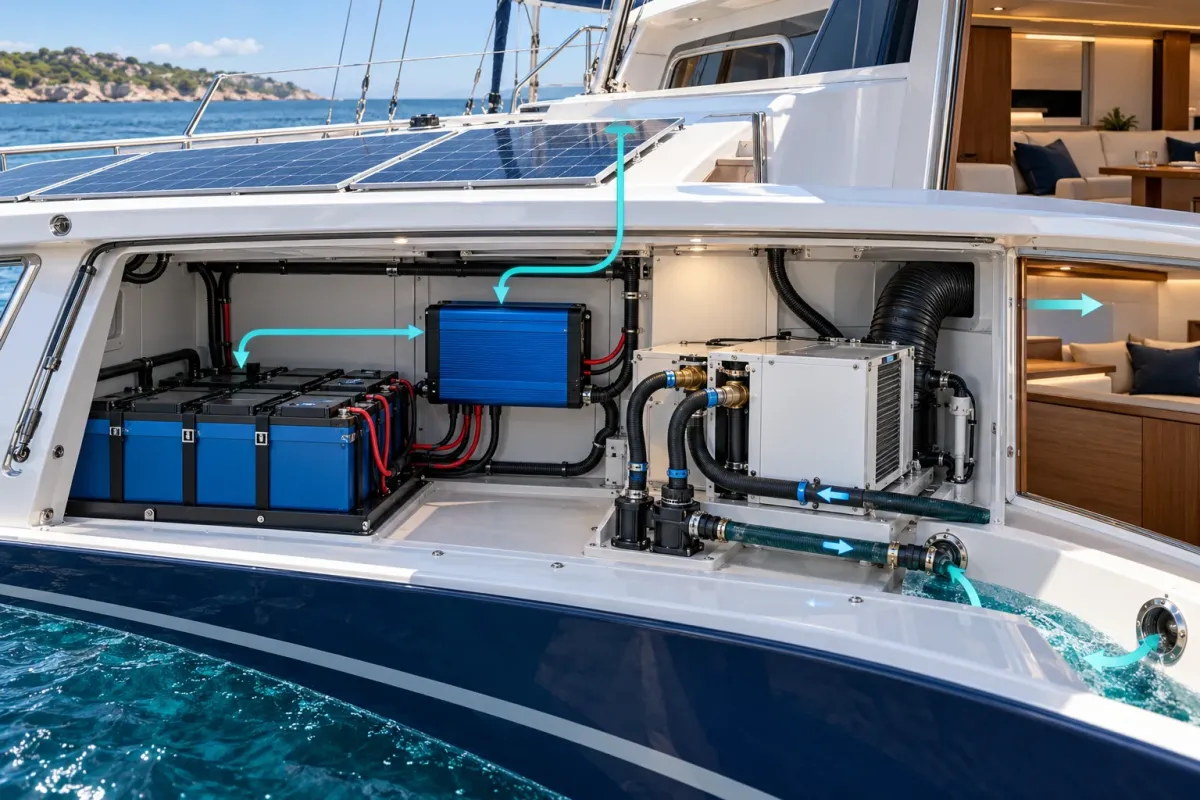
It can, if the air conditioner, inverter, battery bank and charging plan are designed together. A conventional 230 V self-contained unit is an AC load: the battery supplies a compatible inverter, and conversion losses reduce the energy delivered to the compressor. The system may also have substantial startup demand.
Consider an intentionally simplified example using the listed 1,030 W input. Assume a 10 kWh nominal battery, 80% usable capacity and 90% inverter efficiency. The AC energy available to the unit is approximately 10 × 0.80 × 0.90 = 7.2 kWh. At a constant 1.03 kW input, this is about 7 hours of idealized runtime. It excludes other boat loads, reserve margins, battery temperature and aging, and compressor startup. Real runtime should be established with the actual equipment and a battery monitor.
Battery air conditioning has a connected cost: battery capacity, inverter, cables, protection, charging equipment and possibly alternator or solar upgrades. Compare the expected overnight cooling hours against a yacht lithium battery upgrade and realistic solar output, rather than treating the air conditioner as the whole system.
Maintenance and Efficiency
Marine AC performance depends on both air flow and seawater flow. Keep the seawater strainer clear and check the discharge for a steady flow as directed by the manual. Dirty filters, blocked return air, kinked ducts, fouled heat exchangers or restricted cooling water can reduce performance and raise operating time.
Ask the manufacturer or service agent for the current service schedule for the exact model. Include filter cleaning, seawater pump and strainer checks, hose and clamp inspection, condensate drainage, electrical connections and refrigerant service where required. A multi-zone chiller also adds pumps, water circuits and air handlers to the inspection list.
Record energy use, cabin temperature, sea temperature and runtime during normal trips. Those observations help distinguish a high load from a maintenance problem and provide a sound basis for future replacement decisions.
Questions to Ask Before Ordering
- What is the model's cooling capacity and electrical input at the design air and seawater temperatures?
- Does the quote include pump, controls, grilles, hoses, breaker and commissioning?
- What seawater flow, through-hull, strainer and discharge arrangement does the manual require?
- What will the system draw at startup and while running, and can the yacht's shore supply or generator support it?
- How much usable battery capacity and inverter power are needed for the desired runtime?
- Where can filters, pumps and the unit itself be accessed for service or removal?
- Which installation items, taxes, freight, haul-out or carpentry are excluded from the price?
Frequently Asked Questions
How much does yacht air conditioning cost?
Equipment listings vary by capacity and package. The dated example in this guide is €5,120.50 for one 12,000 BTU/h complete kit; installation and vessel changes are additional and require a local quote.
How much electricity does a 12,000 BTU yacht AC use?
It depends on the exact model and conditions. The Dometic MCS T12 retailer listing states 1,030 W input while cooling, which is about 1.03 kWh for each hour at that input.
How long can a yacht AC run on batteries?
Divide usable AC energy after inverter losses by the air conditioner's average electrical input. The seven-hour example above assumes constant rated draw and excludes other loads; actual runtime may differ substantially.
Is a chiller better than a self-contained marine AC unit?
Neither is best for every yacht. Self-contained systems can suit individual cabins; a chiller may suit several zones. Compare total installation, service access, power and the vessel's layout.
Sources and Method
- D-Marine: Dometic MCS T12 package, listed price and electrical specifications (retailer listing checked October 15, 2026).
- Dometic: marine air-conditioning selection and installation guide.
- Webasto: BlueCool S-Series self-contained specifications.
- Webasto: BlueCool C-Series chiller specifications.
- YachtMetric: Yacht Generator Cost.
- YachtMetric: Yacht Lithium Battery Upgrade Cost.