Yacht Lithium Battery Upgrade Cost: AGM vs LiFePO4, Installation and Safety
Compare yacht AGM and LiFePO4 house batteries, complete installation costs, charging changes and overnight energy budgets with transparent worked examples.

Research checked: October 15, 2026
A yacht lithium battery upgrade can provide more usable house energy and quieter time at anchor, but the batteries are only part of the invoice. Charging equipment, battery management, electrical protection, mounting and commissioning can change the final cost substantially.
This guide explains how to compare AGM and LiFePO4 proposals, calculate an overnight energy budget and request a complete installation quote. It covers the house battery bank that supplies onboard electrical loads. Engine starting, thrusters and electric propulsion need their own suitability checks; our hybrid vs diesel yacht guide covers the wider propulsion comparison.
Yacht Lithium Battery Upgrade Cost: Quick Answer
There is no reliable installed price based on yacht length alone. Ask for a quote sized to your daily energy demand, peak electrical loads, existing charging equipment and installation access. A battery-only price cannot establish the cost of converting a finished yacht.
For a dated equipment example, Battle Born's BB10012 product page showed a US-dollar sale price of $799 for the non-heated standard 100 Ah, 12 V model on October 15, 2026, alongside a $949 reference price. This is a single battery listing, not an installed marine system quote or an endorsement. Confirm the selected variant, current price, taxes, freight and installation suitability.
Victron's current price-list page identifies its 2026 Q4 recommended prices as euros per unit excluding VAT and says local prices can vary. Confirm the exact product code and currency, then add the compatible management system and installation work. Recommended equipment prices are reference points, not installed quotations.
| Budget item | What the quote should specify |
|---|---|
| House batteries | Model, chemistry, nominal energy, permitted usable capacity, current limits and warranty. |
| Battery management | Compatible BMS, shutdown controls, alarms and communication equipment. |
| Charging changes | Shore charger, solar controller settings, alternator regulation or DC-DC charging as required. |
| Protection and distribution | Suitable fuses, switches, busbars, cables, terminal covers and monitoring. |
| Mechanical installation | Secure mounting, dry location, service access and removal of old equipment. |
| Labor and handover | Design review, installation, commissioning, documentation, taxes and disposal. |
AGM vs LiFePO4: Compare Usable Energy
AGM is a lead-acid battery type; LiFePO4 is a lithium-ion chemistry also called lithium iron phosphate or LFP. For a buying decision, compare the energy you plan to use between charging periods, the power each bank can supply and the complete system price.
| Question | AGM proposal | LiFePO4 proposal |
|---|---|---|
| How much energy is available? | Request the planned discharge window and capacity at the expected load. | Request the permitted operating window and reserve before BMS shutdown. |
| What can remain in place? | Check compatibility even for an apparently similar replacement. | Review every charging source, protection device and control interface. |
| What powers large loads? | Verify voltage under load and the bank's discharge rating. | Verify both battery and BMS continuous and surge ratings. |
| What is being promised? | Separate warranty, design life and actual service history. | Separate cycle-test conditions, warranty and expected years aboard. |
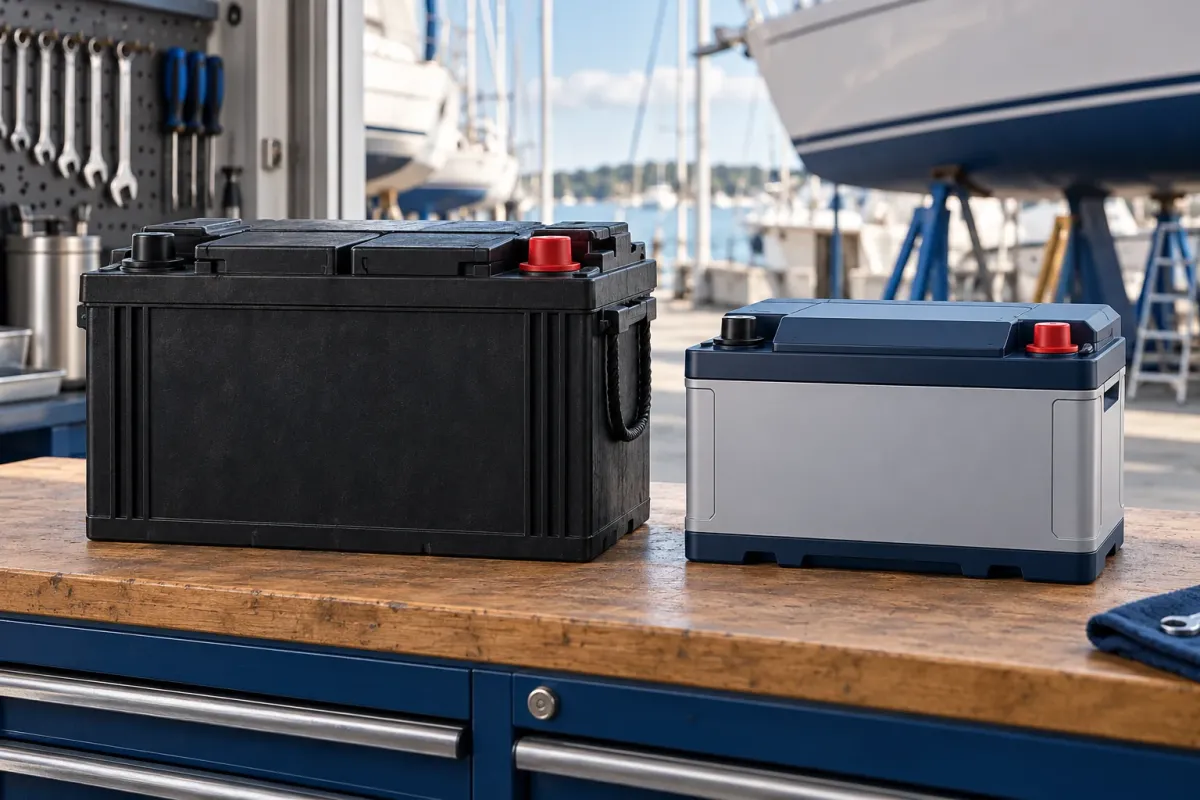
Start with watt-hours or kilowatt-hours rather than comparing amp-hours across different voltages. Nominal energy (Wh) = nominal voltage × rated amp-hours. This is a budgeting conversion; actual energy delivered depends on load, temperature, battery condition and operating limits.
For a clearly hypothetical comparison, a 12 V, 400 Ah AGM bank contains 4.8 kWh nominal. Choosing a 50% planning window allocates 2.4 kWh. A 12.8 V, 250 Ah LFP bank contains 3.2 kWh nominal; an assumed 80% planning window allocates 2.56 kWh. These percentages are selected example inputs, not universal discharge recommendations. Obtain the permitted limits for the actual batteries, then account for reserve and conversion losses.
As a real specification example, Victron's 12.8 V Lithium NG manual lists a 200 Ah module at 2,560 Wh nominal. It also gives product-specific current, temperature and cycle-life conditions. A capacity label alone does not tell you whether a bank can run your inverter or safely charge in your winter storage conditions.
A Worked Installation Budget
The following figures are invented planning allowances in US dollars. They are not dealer quotations, market averages or an estimate for a particular yacht. Their purpose is to show which lines belong in a complete budget.
| Hypothetical item | Allowance |
|---|---|
| LFP battery modules | $2,400 |
| Compatible BMS and controls | $600 |
| Charging-system changes | $800 |
| Monitoring | $400 |
| Cables, protection and mounting | $600 |
| Design, installation and commissioning labor | $1,800 |
| Illustrative subtotal | $6,600 |
Freight, taxes, disposal, major joinery work and a new inverter or alternator are excluded from this example. Some products combine monitoring or BMS functions, so an actual quote should avoid double-counting them. Conversely, a difficult cable route or an undersized existing charger can add work that a battery seller's package does not cover.
Request a second proposal for replacing the AGM bank while meeting the same usable-energy and peak-load requirements. That comparison reveals the incremental cost of lithium more clearly than comparing equal amp-hour labels.
Why Charging Equipment Changes the Price
List every charging source: shore charger, inverter/charger, engine alternator, generator-powered charger and solar controller. Ask the installer which units can be configured and controlled correctly, which need replacement and what happens when the BMS stops charging.
Victron's system-design guide explains how its NG BMS controls loads and chargers and warns about alternator overload when charging lithium batteries. Depending on the system, temperature regulation or current-limiting charging equipment may be required. A compatible charge-voltage setting alone does not resolve all integration questions.
Solar also needs an energy budget. Our yacht solar panel cost guide explains daily generation and shading assumptions. Larger batteries store more energy, but they do not increase the roof's daily solar production. Ask whether the yacht can replenish a normal day's use within the available charging time.
Can the Bank Run the Yacht Overnight?
Build a measured load list before selecting capacity. As an arithmetic example, assume refrigeration averages 80 W over 12 hours, lights and electronics average 60 W for five hours, and other DC loads consume another 0.24 kWh:
- Refrigeration: 0.08 kW × 12 h = 0.96 kWh.
- Lights and electronics: 0.06 kW × 5 h = 0.30 kWh.
- Other DC loads: 0.24 kWh.
- Total example DC energy: 1.50 kWh.
If an AC appliance uses 0.50 kWh and an assumed inverter efficiency is 90%, its battery requirement is approximately 0.56 kWh. Total example demand becomes about 2.06 kWh before inverter standby consumption and any omitted equipment. If the selected usable battery window is 3.2 kWh and you keep 20% of it as planning reserve, 2.56 kWh is allocated to operation. The arithmetic leaves roughly 0.50 kWh of margin under these assumptions.
Air conditioning can change the result quickly: a hypothetical 1 kW average load for eight hours needs 8 kWh at the appliance alone. Compressor startup and maximum power must also be checked separately from energy capacity. Replace all assumed loads with measured values before deciding whether overnight operation is practical. Include a watermaker in the schedule if it will run during the same period.
Safety, Standards and Installer Responsibility
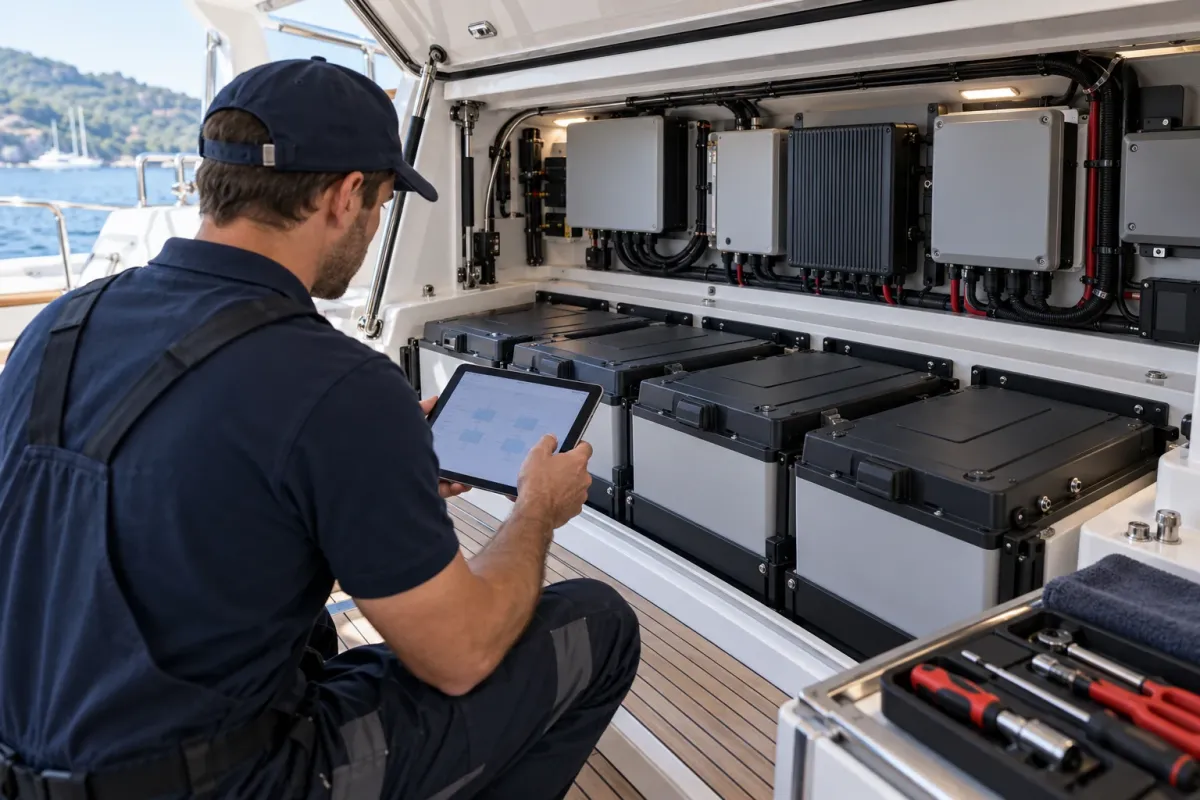
The published scope of ABYC E-13-2025 covers selection, installation and system design for lithium-ion boat batteries and applies to installed systems over 500 Wh. That scope is not a universal legal requirement for every yacht worldwide. Ask the installer which current standards, flag requirements and insurer conditions apply to your vessel and operating area.
A complete proposal should explain how the installation responds to a battery fault, loss of charging and an approaching low-energy shutdown. Identify essential loads that must remain available, how the operator receives warnings and how engine starting is maintained. A product described as “drop-in” still needs a vessel-specific compatibility review.
Request commissioning records covering the approved charge settings, control functions, alarms, isolation and normal operation. Keep the equipment manuals, component list and electrical drawings with the yacht's service records. Confirm any documentation or inspection your insurer requires before approving the project.
Battery Life, Warranty and Payback
Cycle life is a test specification tied to discharge depth and other conditions. It is not a calendar replacement date. Long storage, temperature, charging practice and the condition of the rest of the installation also influence ownership costs.
Victron's warranty page, checked October 15, 2026, lists three years for lithium batteries and two years for lead-acid batteries, with terms and extension options subject to its policy. This differs from the general five-year statement for many of its other power products. Confirm the warranty for the exact battery and seller, including labor, freight and exclusions.
For payback, compare complete alternatives. If a hypothetical AGM replacement costs $1,800 and the lithium project costs $6,600, the initial difference is $4,800. At an assumed $240 annual net saving, simple payback would be $4,800 ÷ $240 = 20 years. Those invented inputs exclude financing, resale and future replacements; they demonstrate the method rather than a typical result.
Only count generator fuel and service that will actually be avoided. Moving electricity production from evening generator use to an engine charging session does not automatically remove its cost. If the main benefit is quieter anchoring, describe that benefit separately from cash savings. Add the quote and any replacement reserve to your wider annual yacht budget.
Questions to Ask Before Accepting a Quote
- What measured daily energy use and maximum loads support the proposed bank size?
- What usable operating window and reserve are assumed?
- Which existing chargers, alternators and solar controllers can remain?
- Does the price include the required BMS, protection, controls and monitoring?
- How are essential loads and engine starting supported during a shutdown?
- What commissioning tests, drawings and operator training are included?
- Which taxes, access work, disposal costs and future service charges are excluded?
- What warranty and local technical support apply to the complete installation?
Frequently Asked Questions
How much does a yacht lithium battery upgrade cost?
Use a complete installed proposal covering batteries, management, charging, protection and labor. This guide's $6,600 subtotal is an invented worked example, not a market-price range.
Can I replace AGM batteries with lithium without other changes?
That depends on the exact equipment and installation. Have every charging source, current limit, control interface and protection device reviewed before treating a battery as a direct replacement.
Will lithium batteries eliminate the generator?
They may reduce generator runtime if the bank supports the loads and can be recharged by other sources. Larger storage alone does not supply the energy consumed each day.
How long will the batteries last?
There is no universal replacement interval. Use product-specific cycle data, warranty terms, operating conditions and diagnostic information to plan future work.
Sources and Method
Sources were checked on October 15, 2026. Product specifications and warranty examples apply only to the identified equipment. The Battle Born equipment price is a dated public listing. The installation budget, discharge-window examples, appliance loads and payback inputs are explicitly hypothetical. We have not conducted an independent installation-price survey or battery test.
- Victron Energy: current recommended-price basis and exclusions.
- Victron Energy: Lithium NG product and manual resources.
- Victron Energy: product-specific capacity, ratings and test conditions.
- Victron Energy: BMS functions and charging integration.
- ABYC E-13-2025: published scope via ANSI.
- Victron Energy: battery warranty distinctions.