Yacht Solar Panel Cost: Installation, Output and Payback
Calculate yacht solar panel cost and daily output, then compare installed quotes and realistic payback assumptions.
Research checked: October 15, 2026
Yacht solar panels can reduce shore-power purchases and generator running, but the panels are only one part of the installed cost. Mounts, wiring, charge controllers, battery compatibility and labor often determine the final quote. The financial return depends on the energy you actually use while away from shore power.
This guide explains how to estimate yacht solar panel cost, daily output and payback without mistaking a panel's watt rating for continuous production.
Yacht Solar Panel Cost: Quick Answer
There is no reliable price per yacht foot. Start with the loads you need to supply, then get a system quote that includes the panels, mounting, wiring, MPPT charge controller, protection, battery integration, commissioning and taxes. As a current component example, Renogy listed a 200 W rigid panel at $179.99 on October 15, 2026. This is a retail component price, not a marine installation quote or an estimate for every panel type. Prices can change.
| Cost item | What to ask the installer |
|---|---|
| Panels | Rated power, dimensions, marine suitability, warranty and attachment method. |
| Structure and mounting | Hardtop reinforcement, deck penetrations, corrosion protection and waterproofing. |
| Electrical equipment | MPPT controller, cable runs, breakers, fuses, isolators and monitoring. |
| Battery work | Compatibility with existing battery chemistry, charger settings and any battery upgrade. |
| Labor and commissioning | Installation, testing, documentation and after-sales service. |
Ask for a line-item quote. A low panel price cannot predict the cost of routing marine-grade wiring through a finished yacht.
How Much Power Can the Panels Produce?
Daily energy (kWh) = array rating (kW) × equivalent peak-sun hours × overall system factor. The system factor accounts for temperature, shading, panel angle and electrical losses. Choose it from site-specific estimates or actual logged output; it is not a universal constant.
For an illustrative 800 W array, four equivalent peak-sun hours and an assumed factor of 0.75: 0.8 × 4 × 0.75 = 2.4 kWh/day. At two peak-sun hours, the same assumptions yield 1.2 kWh/day. Neither figure is a guaranteed yield for a location or season.
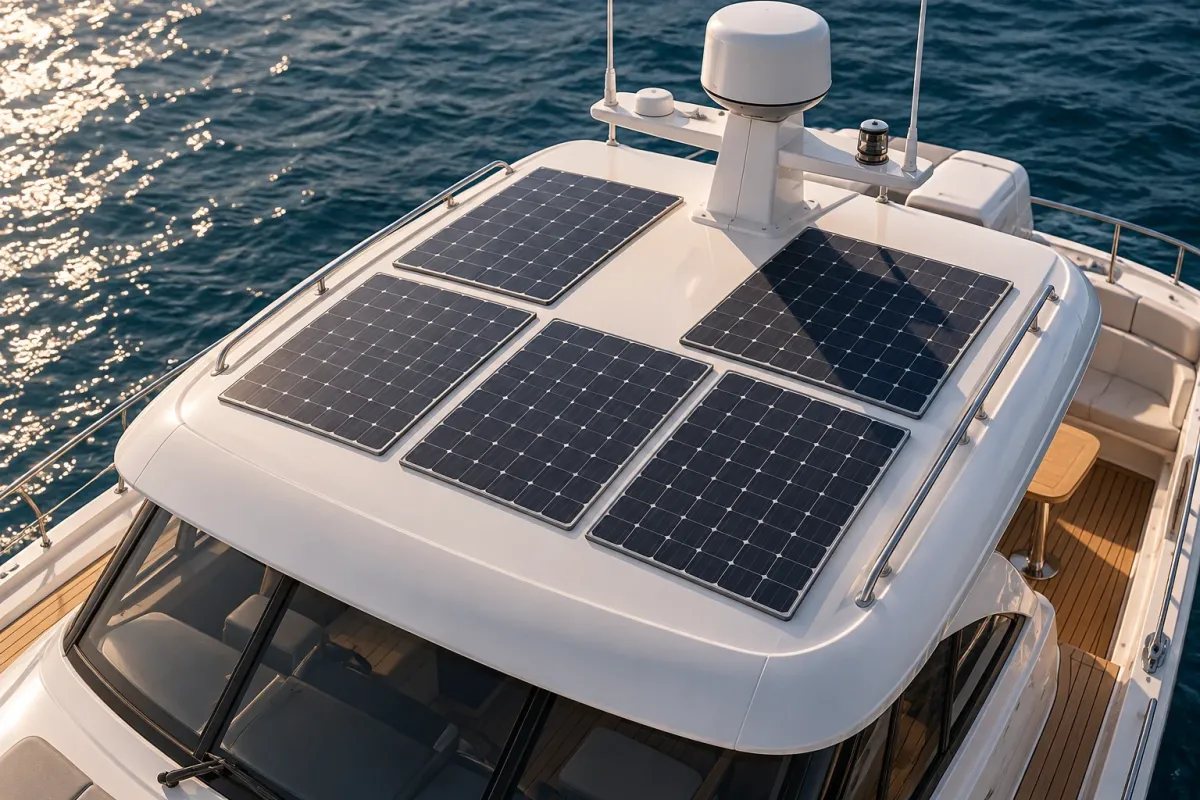
Compare daily energy with a measured load list. For example, a 100 W average refrigeration load over 24 hours uses 2.4 kWh; a 1 kW air-conditioning load running five hours uses another 5 kWh. These are arithmetic examples, not typical loads for every appliance. A modest rooftop array may cover refrigeration in favorable sun while remaining far below air-conditioning demand.
Victron's marine energy guidance describes the MPPT controller's role in charging house batteries, and its controller guidance notes that boats encounter partial shade from sails and other objects. Log actual production and battery use across several days before sizing a final system.
Size the Array to the Yacht, Not Just the Roof
List every electrical load in watts and realistic daily hours. Separate critical overnight loads from occasional high-draw appliances. Then check usable mounting area, shadow patterns, panel cooling, access for cleaning and safe service routes. Solar energy must have somewhere to go: when batteries are full and onboard loads are low, part of the possible generation will not be used.
Ask whether the existing battery bank can accept the charging current and whether the charger settings match its chemistry. If the bank needs replacement, include that in the project budget; a solar quote that omits battery work may understate the real project cost.
What Does a Larger Yacht Array Look Like?
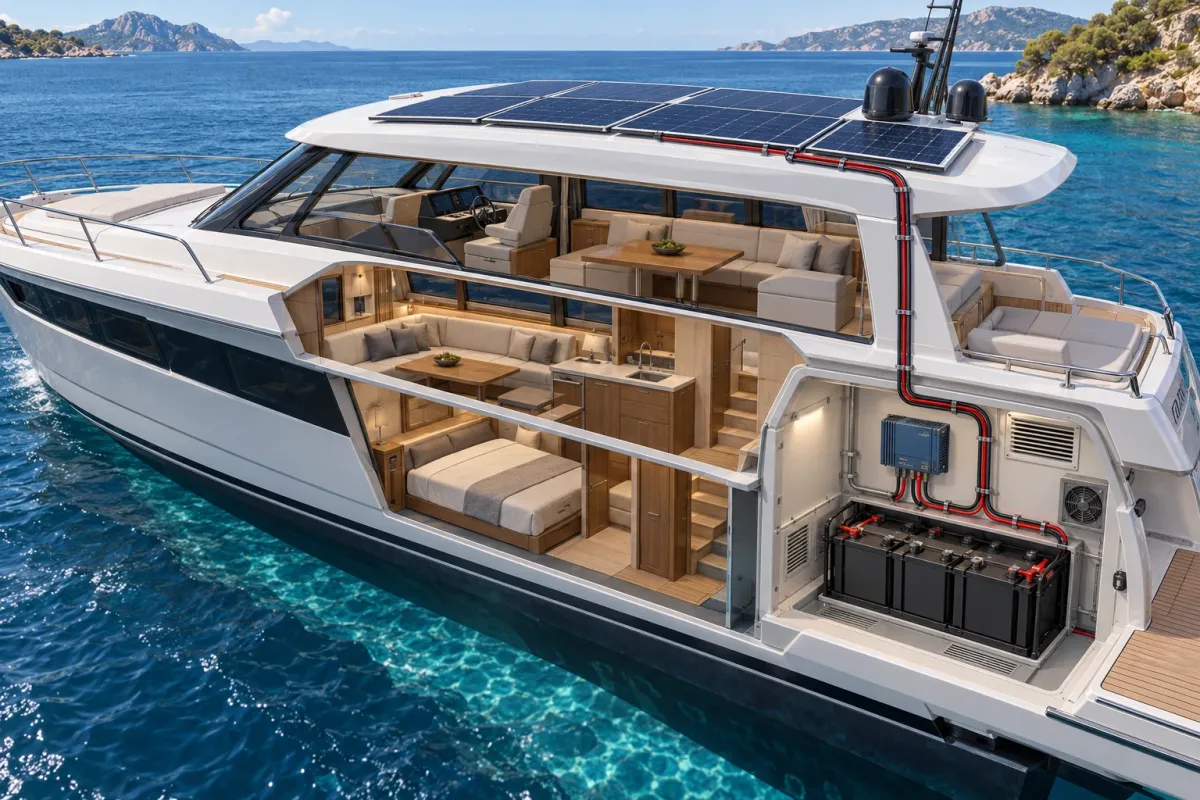
Greenline's published operating scenario assumes a 2.5 kW array generates an average of 12 kWh per day under the builder's modeled conditions. This equates to 4.8 kWh per installed kW in that scenario. It is a useful example of a larger factory-integrated array, not a universal daily output prediction. Sun, season, location, roof geometry and shading change the result.
Do not use solar panel rating alone to claim electric propulsion range. Propulsion power demand is often much higher than a roof array's instantaneous output. For hybrid-yacht range and battery budgeting, see our hybrid vs diesel yacht guide.
Solar Payback: Calculate the Energy Actually Displaced
Simple payback = installed cost ÷ annual net savings. Annual net savings should reflect metered shore electricity avoided, generator fuel and service genuinely avoided, and any maintenance added by the solar system. Do not count the same kWh twice.
Consider a hypothetical $3,000 installed system that delivers 300 kWh of useful energy over a season. If every useful kWh replaces electricity priced at $0.30/kWh, the gross annual saving is 300 × $0.30 = $90. Simple payback is $3,000 / $90 = 33.3 years before maintenance or financing. These inputs are illustrative and are not market averages.
If solar reduces generator runtime, use measured fuel consumption and service costs for the generator's actual operating pattern. A small electrical offset does not necessarily eliminate a generator hour. If batteries were already being charged at no extra cost during a planned engine run, the cash savings may be smaller than the energy produced suggests.
Solar may still be worthwhile for quieter anchoring, less generator runtime and more time away from shore power. Keep those benefits separate from a claimed cash payback. Our fuel guide and annual cost calculator can help compare the rest of the budget.
Questions to Put in an Installation Quote
- What are the panel dimensions, rated output and total installed kW?
- How will the array be fixed, waterproofed and protected from corrosion?
- Where will shade fall during the times the yacht is normally anchored?
- Which controller and battery settings are included?
- What daily and seasonal yield is projected for the cruising area, and what assumptions support it?
- Does the price include wiring, protection, monitoring, commissioning, taxes and any battery change?
- What work can be inspected and maintained without removing finished joinery?
Frequently Asked Questions
Can yacht solar panels run air conditioning?
Only if usable generation and stored energy meet the system's actual draw for the intended hours. Measure the air-conditioning load and compare it with daily solar production and usable battery capacity.
How many panels does a yacht need?
Divide the desired daily energy by a realistic local yield per installed kW, then check whether the required array fits the usable roof area. A panel count without the load and location is unreliable.
Do solar panels eliminate the generator?
They can reduce generator use in some operating profiles. Whether the generator can remain off depends on total loads, weather, battery capacity and time away from shore power.