Yacht Watermaker Cost: Installation, Power Use and Maintenance
Compare yacht watermaker equipment and installation costs, calculate output and power use, and plan filters, flushing and membrane maintenance.
Research checked: October 15, 2026
A yacht watermaker can turn seawater into fresh water and reduce dependence on marina fill-ups. The equipment price is only one part of the budget. A permanent installation may also need a dedicated seawater intake, strainer, overboard discharge, electrical protection, freshwater plumbing, controls and accessible space for routine service.
This guide explains yacht watermaker cost, output, electrical demand and maintenance with current product examples and transparent calculations. Use it to prepare questions for an installer rather than as a quote for a particular yacht.
Yacht Watermaker Cost: Quick Answer
Current equipment examples show why capacity and configuration matter. On October 15, 2026, Rainman's manufacturer price page listed systems in several portable, modular and framed configurations and explained that shipping and local taxes can change the landed price. One dealer listed modular AC units from $4,522 to $5,460, while another listed framed AC systems from $7,359 to $10,820. These are dated equipment listings with different outputs and inclusions; they are not installed-price averages.
| Budget item | What it may include |
|---|---|
| Watermaker equipment | Pumps, membranes, prefilters, controls and any supplied installation kit. |
| Seawater plumbing | Dedicated intake, seacock, strainer, hoses and brine discharge. |
| Freshwater plumbing | Sample valve, tank connection, diversion valve and automatic flushing supply. |
| Electrical work | Cabling, breakers, switching and any inverter, generator or battery changes. |
| Installation and commissioning | Labor, access work, testing, calibration and documentation. |
| Ongoing service | Prefilters, chemicals, pump service, membrane cleaning or replacement and labor. |
Ask for a line-item installed quote. Confirm currency, tax, freight and whether the quoted output is in US gallons or imperial gallons.
How Much Fresh Water Does Your Yacht Need?
Start with measured daily use. Include drinking, cooking, showers, sinks, cleaning, laundry and any crew or guest turnover. Then decide how many watermaker hours per day are realistic.
Required hourly output = daily water demand ÷ planned operating hours.
If six people use an illustrative 20 litres each per day, demand is 120 litres. A unit operated for five hours must average at least 24 litres per hour before adding a margin for changing seawater conditions, filter loading, maintenance downtime and days when operation is unsuitable.
Do not size the unit only from freshwater tank capacity. A 500-litre tank describes storage, while litres per hour describes production. Cruising schedule, reserve policy and the ability to run the watermaker in clean seawater all affect the choice.
Production and Power: A Real Product Example
Spectra lists the Ventura 150D at more than 6 US gallons, or about 24 litres, per hour. Its manual gives a normal production range of 5.7–6.5 US gallons per hour and an operating draw of 9 A at 14 V DC or 4.5 A at 26 V DC.
Using the 14 V figure, the nominal electrical input is 14 V × 9 A = 126 W. Producing 120 litres at 24 litres per hour takes five hours, so the simplified energy calculation is 126 W × 5 h = 630 Wh. Allow additional energy for startup, flushing, controls and real operating conditions. Manufacturer output can also vary with temperature, salinity and system condition.
For a 12 V battery budget, 630 Wh is 52.5 Ah before allowing for battery voltage under load and other losses. Do not mix a 14 V running specification with a 12 V amp-hour result without stating the conversion. Use measured energy at the battery or inverter for a real cruising budget.
DC, AC or Portable Watermaker?
| Configuration | Useful when | Check before buying |
|---|---|---|
| Low-power DC | You want long runs from batteries or solar and moderate output. | Energy per litre, cable size, battery capacity and daily operating hours. |
| Higher-output AC | You have suitable generator or shore-supported AC power and want shorter runs. | Startup load, voltage and frequency, generator loading and noise. |
| Portable | You want minimal permanent modification or may move the system between boats. | Storage, setup time, hoses, power connection and safe intake location. |
| Permanent modular or framed | You want integrated operation and fixed plumbing. | Service access, through-hulls, structural mounting and winter storage procedure. |
A low watt figure is not enough by itself. Compare watt-hours per litre or per gallon at the same test conditions. A faster AC system can draw more power but run for fewer hours. A highly efficient DC system may suit a solar-supported yacht even if its hourly output is lower. See our yacht solar panel cost guide before claiming that an array can cover the watermaker and all other onboard loads.
Why Installation Cost Varies
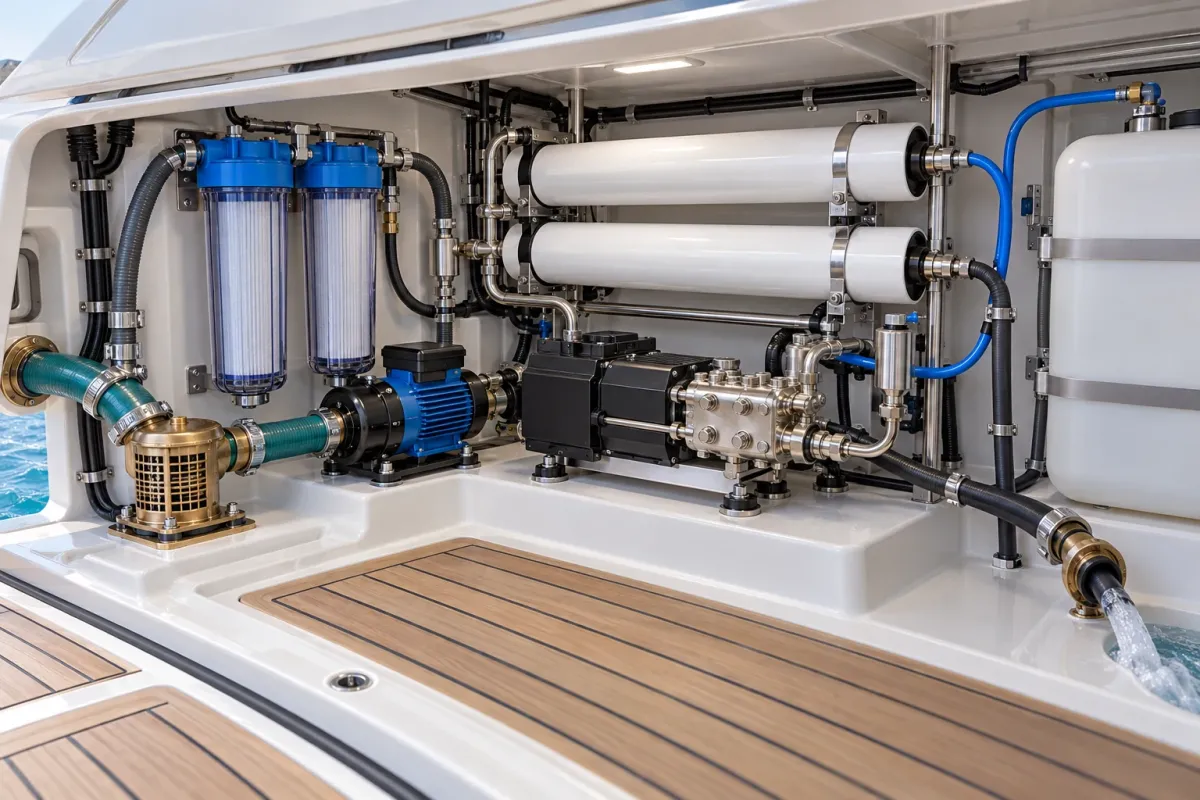
Watermakers Inc.'s installation manual calls for a suitable seawater inlet and strainer, a separate overboard outlet, correctly sized electrical protection and enough access for filter and oil changes. It also warns that routine service can spill saltwater, so component placement matters.
A simple installation with short cable and hose runs can require much less labor than a finished yacht where joinery must be removed and equipment relocated. Through-hull work may also require haul-out. Ask the installer to identify:
- Whether a new dedicated intake and seacock are required.
- Where brine will discharge and product water will be sampled before entering the tank.
- How prefilters and membranes can be removed without dismantling other equipment.
- Whether the electrical system can support continuous and startup loads.
- How the unit will flush automatically when the yacht is unattended.
- Whether the price includes haul-out, carpentry, freight, taxes and commissioning.
Maintenance and Membrane Life
Prefilter life depends heavily on feed-water cleanliness. Spectra advises operating in cleaner open-ocean water rather than harbors or inland waterways when practical, because dirty water shortens filter life. Never make potable water where contamination may be present unless the manufacturer and a qualified professional confirm the system and conditions are appropriate.
The Ventura manual requires a freshwater flush after use. Storage, winterization and long idle periods may require additional procedures and approved chemicals. Follow the exact manual for the installed model; inconsistent flushing can damage or foul membranes.
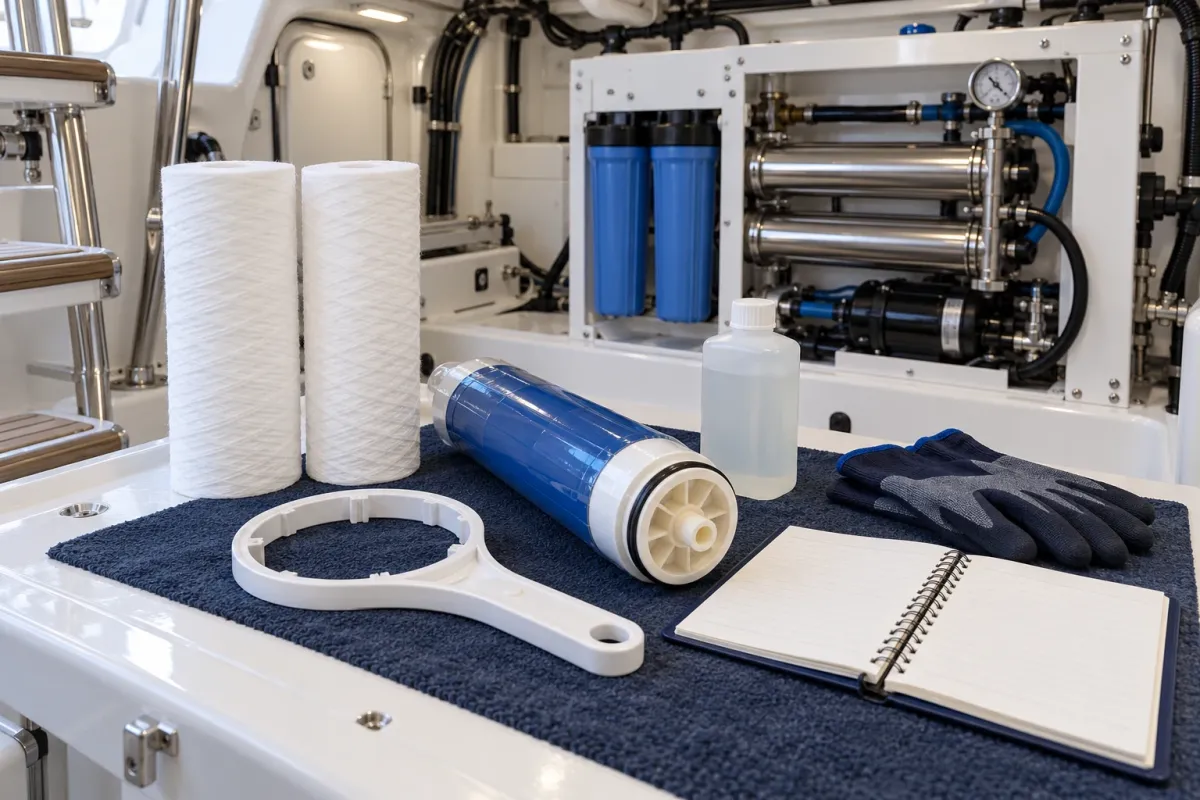
A membrane is not automatically replaced on a fixed calendar. Feed-water quality, operating pressure, flushing, storage and cleaning history all matter. Ask the supplier for current prices for the exact prefilters, membrane elements, pump kits and annual service before comparing systems.
Worked Cost per Litre Example
Suppose a hypothetical installed system costs $7,500 and produces 20,000 litres over the owner's planned holding period. Spreading the installation cost alone gives $7,500 ÷ 20,000 = $0.375 per litre. If filters, service, energy and repairs total another illustrative $2,000, the combined figure becomes $9,500 ÷ 20,000 = $0.475 per litre.
This calculation excludes financing, resale value and the value of time saved by avoiding marina visits. It also assumes the full 20,000 litres are actually produced. Low-use owners may pay much more per litre even when the equipment works perfectly.
A watermaker often delivers operational freedom rather than a short financial payback. Compare the total installed and service cost with marina water prices, transport costs, cruising plans and the value you place on longer stays at anchor. Add the final quote to the Yacht Annual Cost Calculator.
Buying Checklist
- Daily water requirement and desired reserve.
- Rated and expected output in local water temperature and salinity.
- Energy use per litre, including the complete system.
- Available DC or AC power and generator implications.
- Intake, discharge, tank and automatic-flush plumbing.
- Space for operation, ventilation, leaks and service access.
- Local dealer coverage and availability of filters, membranes and pump parts.
- Written equipment, installation and annual-service prices.
Frequently Asked Questions
How much does a yacht watermaker cost?
Current equipment listings for smaller and mid-output systems often run several thousand dollars before installation. The complete cost depends on output, power source, controls, plumbing, electrical work, taxes and access aboard the yacht.
How long should a watermaker run each day?
Divide daily water demand by realistic hourly output. Add operating margin and follow the manufacturer's minimum run, flushing and storage instructions.
Can solar panels run a yacht watermaker?
Some efficient DC models can operate within a suitable solar and battery budget. Compare total daily watermaker energy with expected solar generation and all other onboard loads.
Can a watermaker be used in a marina?
Manufacturers commonly recommend cleaner seawater because harbor contamination and suspended material can foul filters and membranes. Follow local rules and the instructions for the exact system.
Sources and Method
- Rainman: current pricing structure and inclusions.
- The Yacht Rigger: dated modular Rainman equipment listings.
- Watermakers Inc.: dated framed Rainman equipment listings.
- Spectra: Ventura 150D output and product information.
- Spectra: Ventura 150/200T operating manual.
- Watermakers Inc.: installation and access requirements.